Rudder is Complete!
 Feb 20, 2010 – Woohoo! The rudder is complete! Some of the fun stuff I’ve read about that are challenges are now behind me.
 I started by riveting the trailing edge that I had assembled a week or so ago using the L-angle to keep it all straight. Riveting was interesting, because the rivets are double-flush, meaning that they have to be flat on both sides. It’s also necessary to keep the trailing edge straight. Riveting incorrectly could result in the trailing edge bowing. During the process, I had a very slight bow in the center of the edge, but it worked itself out nicely. I’m kinda not fond of the “acorn-in-a-dimple” look that Van’s describes. I may fill these with sealant, or just wait until the airplane gets painted and fill them then to make it smooth.
The next thing I had to deal with was a few rivets that were in the trailing edge of the top and bottom ribs for the rudder. Since the rudder tapers to a very thin edge, the ribs also are very thin at that point, so I couldn’t get a bucking bar in there to rivet the aft two rivets on each side, top and bottom. So I back-riveted them indirectly, using a long, thin bar with the rudder sandwiched in between the bar and a bucking plate. Shot the top of the bar with the rivet gun. Works great.


Then it was time for the fun. I had to roll the leading edges of the skins to produce the airfoil shape. I had an extension for a ceiling fan lying around (Now I know why I don’t throw things away). I taped it to the skin, and turned the tube using a screwdriver on one end, and vise-grips in the rudder hing cutout areas. The challenge is to keep the skin from creasing at the spar.


The rolls came out OK. Had to manually finesse the skins a little bit, but I got them to cleco together. This was really hard at the lower end of the rudder, because the rudder is wider there, and the material has to roll farther to mate up.


I then removed the clecos, ran a bead of sealant along the mating surface, and clecoed them back together again. THAT was hard. If I was doing this again, I wonder if I wouldn’t make a thin narrow strip of aluminum to go on the inside of the leading edge, just to reinforce the skin where it is riveted.
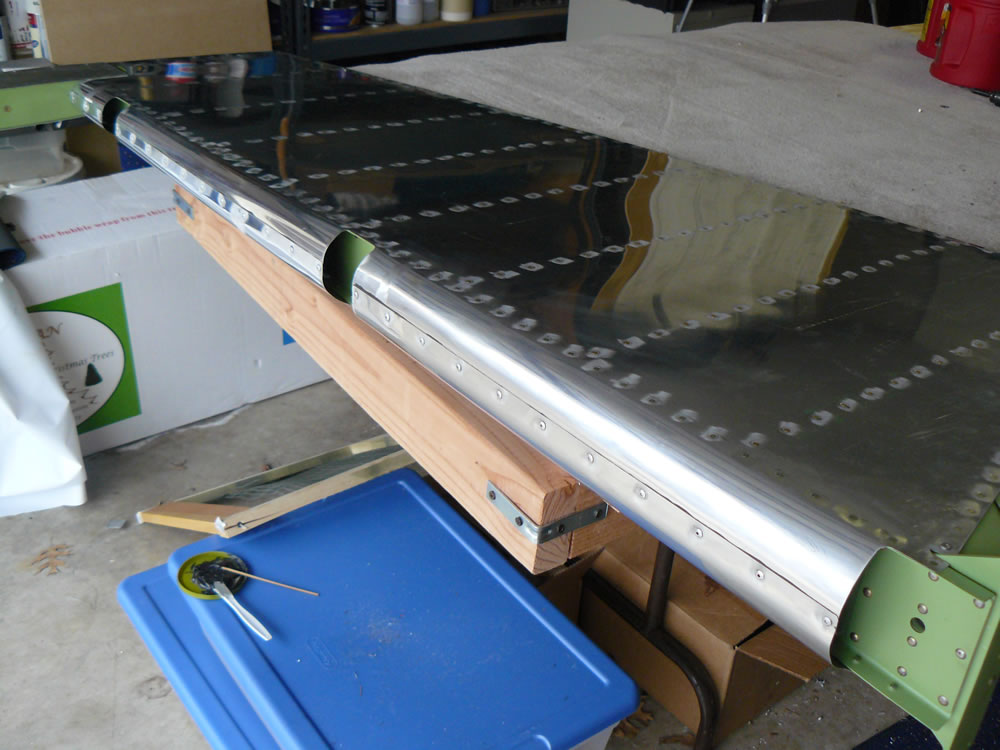 The leading edge then gets riveted with pop-rivets. Looks great.
 I used some leftover sealant to fillet seal the balance skin that I talked about earlier.
Time : 4:15
